
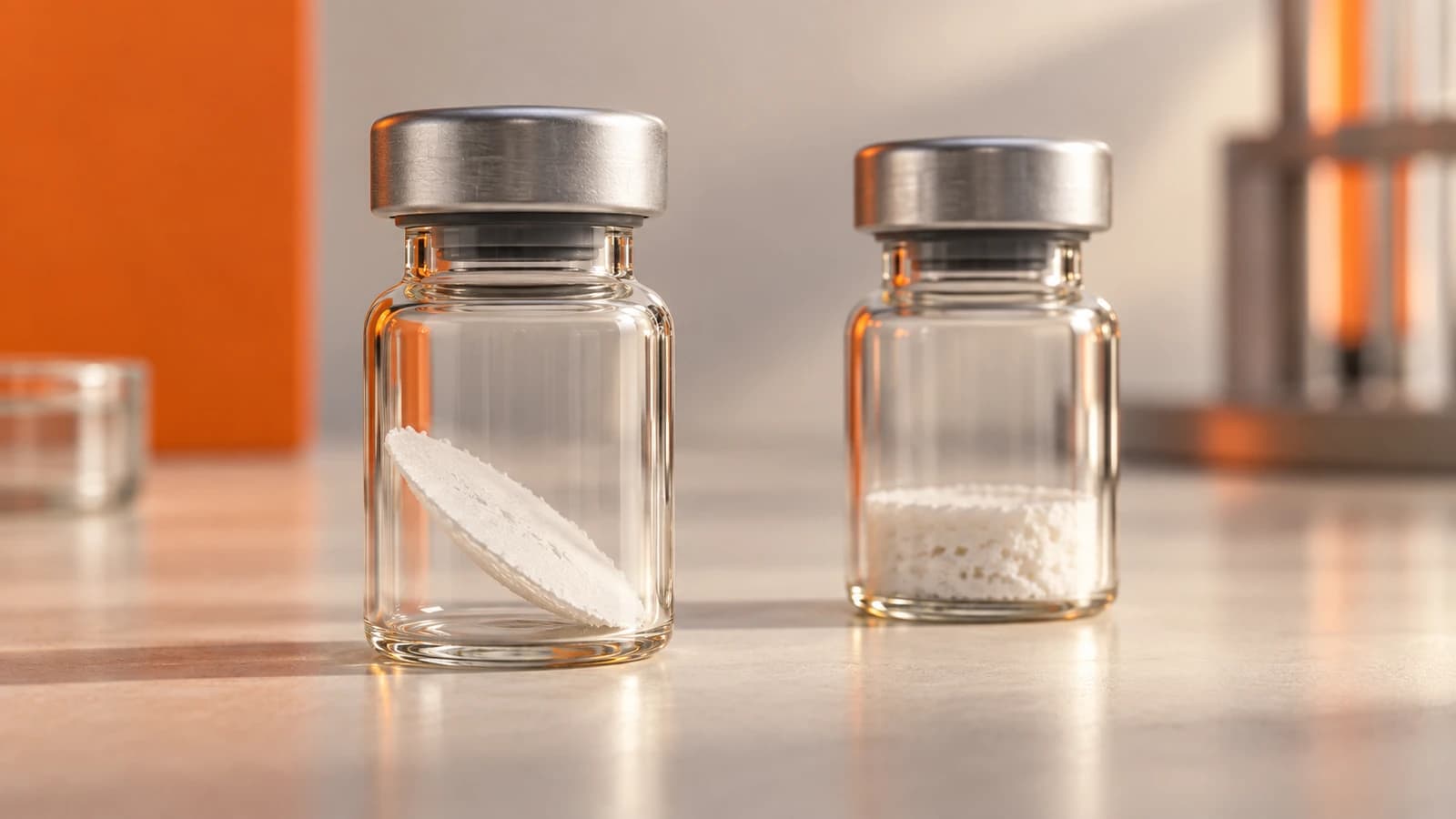
Why Does Lyophilized BPC-157/TB-500 Look Like a Movable Wafer Instead of a Solid Cake?
In this article
Quick Answer: The physical transition of lyophilized research compounds like BPC-157 and TB-500 from a fixed "solid cake" to a "movable wafer" is a natural outcome of the freeze-drying (lyophilization) process. A loose wafer forms when the sublimation process is highly efficient, removing nearly all moisture and causing the peptide-excipient matrix to slightly contract and detach from the glass vial wall. Visual appearance—whether a fixed puck or a loose flake—has zero correlation with the peptide's purity, mass, or efficacy. Only third-party analytical testing (HPLC/MS) can verify product quality.
As a researcher, clinic owner, or peptide distributor, you are likely accustomed to opening a vial of BPC-157 or TB-500 and seeing a solid, immovable white "puck" fixed to the bottom. However, recent discussions across peptide research communities and forums have highlighted a common scenario: receiving high-quality research materials where the lyophilized content looks like a dry, loose wafer that moves freely when the vial is tilted.
Is this physical form normal? Yes. At Torapep—a leader in High-Integrity Tissue Regeneration & Orthopedic Research Compounds—we believe in radical transparency regarding peptide manufacturing. Here is the exact science behind why lyophilized peptides change shape and how to properly assess their quality.
The Science of Lyophilization: Fixed Cake vs. Movable Wafer
Lyophilization is a sophisticated dehydration process used to preserve fragile peptide structures. It involves freezing the liquid peptide solution and then reducing the surrounding pressure to allow the frozen water to sublimate directly from a solid phase to a gas phase.
The final physical appearance of the peptide is primarily influenced by three factors:
- The Vacuum Phase: The intensity and duration of the vacuum during sublimation.
- Moisture Content: The trace amount of water left in the matrix.
- Excipients: Additives like mannitol or glycine used to stabilize the peptide and give the powder volume.
Parameter Comparison: Visual Formats in Lyophilized Vials
Swipe or scroll to compare all columns.
| Parameter | The "Solid Cake/Puck" | The "Movable Wafer/Flake" |
|---|---|---|
| Glass Attachment | Adheres strongly to the inner walls of the vial. | Detached from the walls, moving freely when tilted. |
| Moisture Content | May contain microscopically higher (but still acceptable) trace moisture helping it cling to glass. | Extremely low moisture content; hyper-efficiently dried. |
| Matrix Contraction | Minimal contraction during the secondary drying phase. | The crystalline matrix contracts slightly upon total water removal, snapping away from the glass. |
| Quality Impact | Normal and acceptable. | Normal and acceptable. Often indicates a highly refined drying cycle. |
When a vial appears as a "movable wafer," it simply means the crystalline structure has detached from the glass wall. This is a purely mechanical reaction to the vacuum drying process and changes nothing about the molecular integrity of the peptide.
Addressing the Misconception: Appearance vs. Purity
A common instinct among researchers is to determine purity from appearance alone. If a new vial looks different from a previous batch, concerns arise. However, as chemical experts and seasoned researchers consistently point out: appearances have absolutely no correlation with purity and mass.
A massive, fluffy cake does not mean you received "more" active peptide (it usually just means more excipient filler). Conversely, a compact, loose wafer does not mean the peptide is degraded or under-dosed.
How to Truly Verify Peptide Quality
The only scientifically sound method to determine the purity and mass of your research materials is through independent third-party laboratory testing.
At Torapep, every single batch of our compounds undergoes rigorous Quality Control. We rely on high-performance liquid chromatography (HPLC) for purity and mass spectrometry (MS) to confirm molecular weight. We encourage all researchers to Verify COA (Certificate of Analysis) before initiating any studies.
Explore Torapep's High-Integrity Research Compounds
Whether your research focuses on orthopedic healing, tissue regeneration, or anti-inflammatory pathways, Torapep provides pure, verified, and stable compounds.
- BPC-157 + TB-500 Blend: The ultimate synergistic combination for advanced tissue and tendon recovery research.
- BPC-157 (Body Protection Compound): Our flagship compound, highly sought after for gastrointestinal and musculoskeletal research.
- TB-500 (Thymosin Beta-4 Fragment): Engineered for studies targeting cellular migration, actin upregulation, and accelerated wound healing.
- KPV Peptide: A potent tripeptide utilized in powerful anti-inflammatory and dermatological research.
Browse our complete inventory via the Torapep Product Catalog.
Partner with Torapep for Your Clinic or Brand
Torapep is more than just a retail supplier; we are a foundational partner for clinics, med spas, and independent brands demanding the highest standards in peptide manufacturing.
- Looking for Bulk Orders? Explore our Wholesale & Private Label programs to scale your brand with premium DDP shipping and low MOQs.
- Need Specific Formulations? Our Custom Peptide Synthesis team can manufacture bespoke compounds tailored to your exact research parameters.
- Ready to Order? Request a Quote today for exclusive bulk pricing, or chat directly with our team via Sales Chat.
For any other inquiries regarding our manufacturing processes or partnerships, please visit our Contact Page.