
Oral BPC-157, Arginate Salt Labels, and Lyophilized Vials: What Buyers Are Actually Comparing Across Peptide Delivery Formats
In this article
- Quick Reference / Key Takeaways for Sourcing Desks
- 1. The Chemistry of Oral Delivery: Acetate vs. Arginate Salts
- 2. Format Comparison Matrix: Oral Capsules vs. Lyophilized Vials
- 3. The Labeling Trap: What Are You Actually Paying For?
- 4. Systemic vs. Localized Research: Selecting the Right Route
- 5. Sourcing High-Integrity Formulations: The Torapep Standard
- Secure Your Orthopedic Peptide Supply Today
Quick Reference / Key Takeaways for Sourcing Desks
- Chemical Identity: The active biological agent in all BPC-157 presentations is the identical pentadecapeptide sequence (Gly-Glu-Pro-Pro-Pro-Gly-Lys-Pro-Ala-Asp-Asp-Ala-Gly-Leu-Val, molecular weight 1419.5 g/mol).
- Counter-Ion Chemistry: The "arginate" designation refers solely to an L-arginine counter-ion paired with the peptide backbone to protect against gastric acid degradation in non-injectable models, whereas lyophilized vials predominantly utilize an acetate counter-ion.
- Delivery Trade-Offs: Pre-packaged oral capsules offer convenient administration for gut mucosal targets, but commercial capsule labels often mask low actual active peptide mass beneath proprietary filler ratios. Pure lyophilized vials remain the analytical benchmark for verified dosage, long-term stability, and maximum systemic bioavailability.
Across orthopedic recovery boards, peptide forums, and procurement discussions—including recent threads on r/Biohackers exploring non-injectable compounds—buyers from medical clinics, wellness practices, reseller networks, and private laboratories face a persistent question: What is the practical and chemical difference between oral BPC-157 capsules, arginate salt claims, and vacuum-sealed lyophilized vials? Does an "arginate blend" truly justify a 5x price premium over standard freeze-dried active peptide cakes?
Procurement teams frequently encounter fragmented marketing. Retail brands tout "stable oral BPC arginate" capsules as breakthrough alternatives for buyers who wish to avoid sterile needles, cold storage overhead, and reconstitution procedures. Yet these same retail bottles often omit the exact active milligram breakdown, leaving purchasers unsure whether they are paying for active pentadecapeptide or inert L-arginine excipient.
At Torapep, our manufacturing and synthesis standards center on High-Integrity Tissue Regeneration & Orthopedic Research Compounds. Below, our analytical team breaks down the gastric chemistry of arginate salts, bioavailability mechanics, label transparency risks, and how to source the correct product format for your operational needs.
1. The Chemistry of Oral Delivery: Acetate vs. Arginate Salts
To understand why "arginate" is marketed heavily for oral and sublingual applications, one must examine gastric peptide kinetics.
Peptides are linear chains of amino acids linked by amide bonds. In standard solid-phase peptide synthesis (SPPS), the synthesized sequence is typically paired with an acetate counter-ion ([C62H98N16O22] · x CH3COOH). When administered via standard aqueous injection, BPC-157 acetate bypasses the digestive tract entirely, delivering 100% systemic distribution without chemical breakdown.
However, when ingested orally:
- Gastric Acid Cleavage: The low pH of the stomach (1.5--2.5) and endogenous gastric proteases (pepsin) can hydrolyze unprotected peptide bonds.
- The Arginate Mechanism: BPC-157 Arginate pairs the negative carboxyl groups of the peptide with basic L-arginine counter-ions. The dibasic guanidinium group on L-arginine provides ionic shielding, substantially increasing the peptide's resistance to acidic gastric degradation in artificial gastric juice models compared to untreated free base or simple salts.
While BPC-157 exhibits native resilience in gastric juice relative to other peptide classes, pairing it with an arginate counter-ion enhances stomach survival, making it specifically suited for localized gut mucosal research.
2. Format Comparison Matrix: Oral Capsules vs. Lyophilized Vials
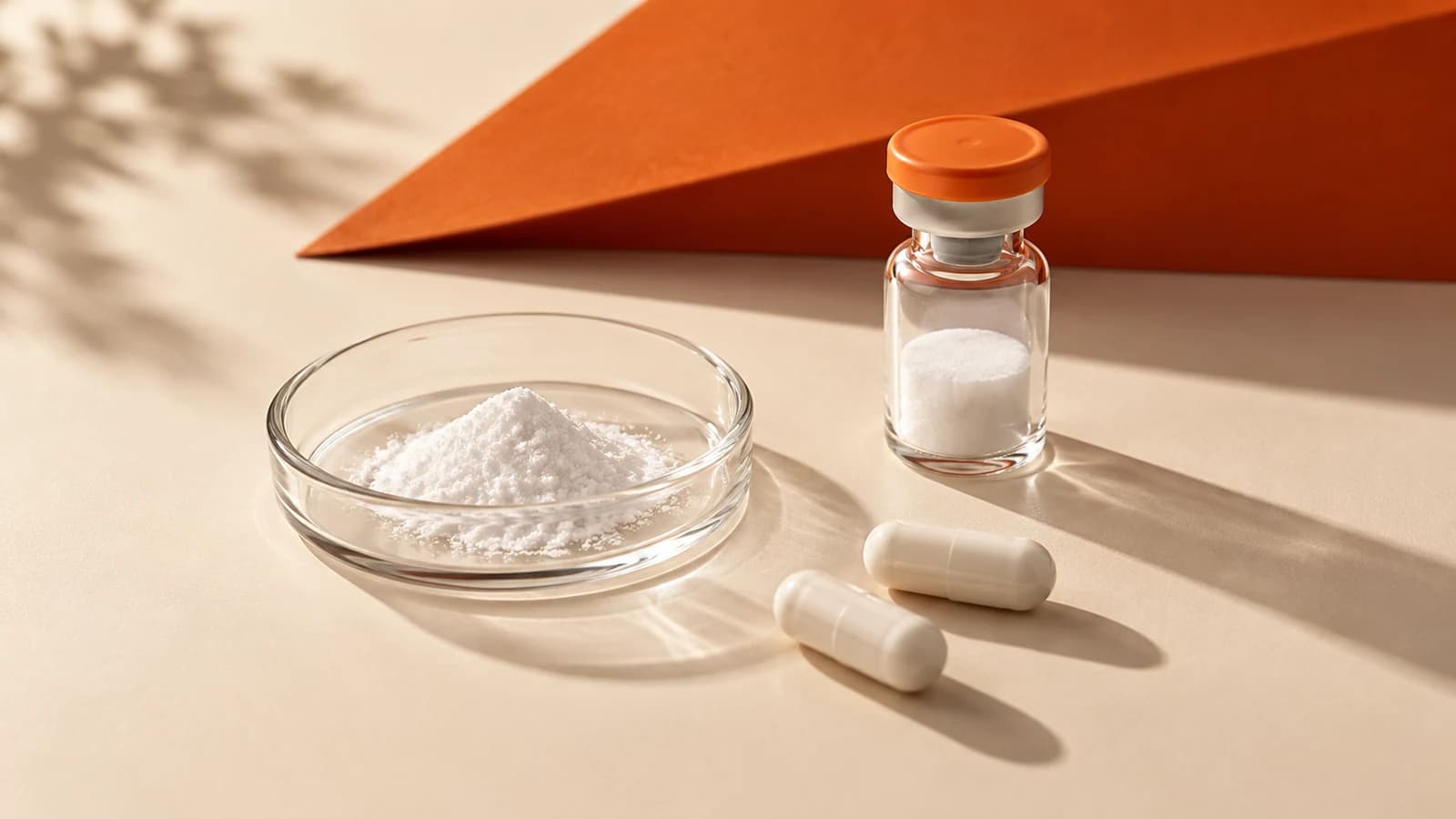
When clinics, resellers, and independent purchasers evaluate catalog listings, they are comparing three distinct physical presentations:
               ┌─────────────────────────────────────────────────────────┐
               │           Pure Synthesized BPC-157 Sequence             │
               │                   (HPLC ≥99.0%)                         │
               └────────────────────────────┬────────────────────────────┘
                                            │
                    ┌───────────────────────┴───────────────────────┐
                    ▼                                               ▼
       ┌──────────────────────────┐                    ┌──────────────────────────┐
       │   Oral Arginate Powder   │                    │  Lyophilized Sterile     │
       │   (Capsules / Tablets)   │                    │  Cake Vials (Acetate)    │
       └────────────┬─────────────┘                    └────────────┬─────────────┘
                    │                                               │
       ┌────────────┴─────────────┐                    ┌────────────┴─────────────┐
       ▼                          ▼                    ▼                          ▼
Gastric Mucosal Focus       Zero Injection       Systemic Bioavailability   Verifiable Mass &
(Localized GI Target)       Maintenance Needs    (Deep Connective Repair)   Raw Peak Purity
Swipe or scroll to compare all columns.
| Evaluation Parameter | Oral BPC-157 Arginate Capsules | Raw Cosmetic/Oral Bulk Powder | Lyophilized Vials (Acetate Form) |
|---|---|---|---|
| Primary Physical State | Encapsulated powder blend with fillers | Free-flowing crystalline bulk active | Vacuum-sealed freeze-dried porous cake |
| Common Sourcing Profiles | Medspas, retail clients, private buyers | Contract capsule manufacturers, brands | Orthopedic clinics, research teams, resellers |
| Systemic Bioavailability | Lower (~5% to 15% absorbed intact) | Formulation dependent | High (Direct systemic availability) |
| Target Application | Localized gastric/gut lining support | High-throughput batch compounding | Systemic joint, tendon, and ligament protocols |
| Active Milligram Accuracy | Frequently obscured by proprietary ratios | Exact bulk weight (g / kg) | Exact active milligrams per vial (e.g., 5mg/10mg) |
| Storage & Temperature | Ambient room temperature stable | Hygroscopic; store at -20°C | Hermetic inert N2 seal; 24+ months at -20°C |
| Cost per Milligram | Highest (Significant retail markups) | Lowest manufacturing base cost | High cost efficiency; factory-direct tiering |
3. The Labeling Trap: What Are You Actually Paying For?
A frequent complaint on Reddit peptide boards is the lack of label transparency in pre-made oral products: "A lot of oral BPC brands don't necessarily have this or disclose it so it can be hard to tell if the BPC has what it needs to do its job orally."
The root of this issue is commercial active-to-counter-ion ratio dilution:
- In an authentic BPC-157 arginate preparation, L-arginine makes up a substantial portion of the combined molecular weight.
- A retail capsule claiming "500 mcg BPC-157 Arginate" often contains only ~350 mcg of actual active peptide backbone, with the remainder being the L-arginine salt.
- In lower-tier consumer brands, manufacturers combine minimal active peptide with inexpensive bulk L-arginine powder and rice flour fillers, listing a misleading "proprietary blend" on the supplement facts panel.
By contrast, purchasing analytical-grade lyophilized vials guarantees unambiguous dosing. When an authentic vial specifies 5mg or 10mg of BPC-157, that metric represents pure active sequence verified by independent chromatography—free of mystery excipients, unlisted ratios, or degraded carrier compounds.
4. Systemic vs. Localized Research: Selecting the Right Route
Deciding between oral delivery and standard lyophilized presentations comes down to your operational and anatomical targets:
- When Oral Delivery Makes Sense: Oral BPC-157 (specifically when stabilized as an arginate salt) is well-suited for investigations focused directly on the gastrointestinal tract—including gut barrier permeability, inflammatory bowel assays, and esophageal mucosal integrity. The compound acts locally on mucosal tissue before systemic first-pass hepatic metabolism degrades the remaining fraction.
- When Lyophilized Vials Are Indispensable: If the research target involves distal tissue repair, tendon-to-bone healing, ligament tears, or systemic joint mobility, oral delivery is pharmacokinetically inefficient. Achieving therapeutic systemic plasma levels via the oral route requires massive, cost-prohibitive daily gram doses. Reconstituting sterile freeze-dried vials ensures precise, un-degraded, systemic tissue distribution.
Furthermore, for deep orthopedic recovery models, standalone BPC-157 is frequently augmented by multi-pathway cellular migration agents. Evaluating dual-action recovery protocols? Review our dedicated dual-peptide formulation: Torapep BPC-157 + TB-500 Co-Lyophilized Vials to explore how actin-sequestering thymosin fragments amplify focal vascular repair.
5. Sourcing High-Integrity Formulations: The Torapep Standard
Whether you operate an orthopedic wellness practice, supply regional wellness networks, run private research, or manage direct distribution, you should never have to compromise on analytical proof.
Torapep enforces uncompromising manufacturing standards across our entire Torapep Peptide Catalog:
- Dual-Spectrometry Verification: Every production run of Torapep BPC-157 Lyophilized Vials undergoes High-Performance Liquid Chromatography (HPLC) to verify chromatographic purity ≥ 99.0%, alongside Liquid Chromatography-Mass Spectrometry (LC-MS) confirming exact molecular weight (1419.5 g/mol).
- Rigorous TFA Salt Depletion: Our automated solid-phase synthesis incorporates extensive ion-exchange steps to deplete toxic residual trifluoroacetic acid (TFA), delivering pure, stable acetate salts with neutral reconstitution pH values.
- Transparent Raw Chromatogram COAs: We do not issue generic text certificates. Every production batch is paired with full baseline integration spectra and third-party blind testing reports, instantly accessible via the Torapep COA Verification Portal.
Secure Your Orthopedic Peptide Supply Today
Eliminate unverified capsule ratios, questionable arginate labels, and inflated reseller markups. Build your foundational knowledge by accessing our full scientific dossier on the Torapep BPC-157 Research & Mechanism Hub.
Ready to secure consistent, factory-direct inventory for your clinic, brand, or private laboratory? Submit an Institutional & Bulk Quote Request directly to our synthesis operations desk today for tiered wholesale pricing, OEM private-label capabilities, and insured, DDP-compliant delivery.
Disclaimer: All compounds and formulations discussed are synthesized, purified, and distributed strictly for in-vitro laboratory research, analytical development, and professional compounding evaluation (Research Use Only, RUO). Not intended for unapproved human ingestion, veterinary clinical use, or medical diagnostics.