
Why Did Your Second Batch of BPC-157 Feel Different? How to Audit Lot Numbers, Net Peptide Content, and Identity Across Repeat Orders
In this article
- Quick Reference / Direct Sourcing Takeaways
- 1. The Root Causes of Batch-to-Batch Discrepancies
- 2. Physical Inspection vs. Analytical Verification Matrix
- 3. The 4-Step Replenishment Audit for Sourcing Desks
- 4. Orthopedic Synergy: Deploying BPC-157 Alongside Multi-Pathway Peptides
- 5. Sourcing Factory-Direct Integrity: The Torapep Benchmark
- Eliminate Batch Variance from Your Supply Pipeline
Quick Reference / Direct Sourcing Takeaways
- The "Same Vendor, Different Results" Mystery: Discrepancies between repeat orders from the same supplier rarely stem from sequence alterations; they almost always result from fluctuating net peptide content, incomplete trifluoroacetic acid (TFA) salt depletion, variable lyophilization excipient bulk, or batch-level pH drift.
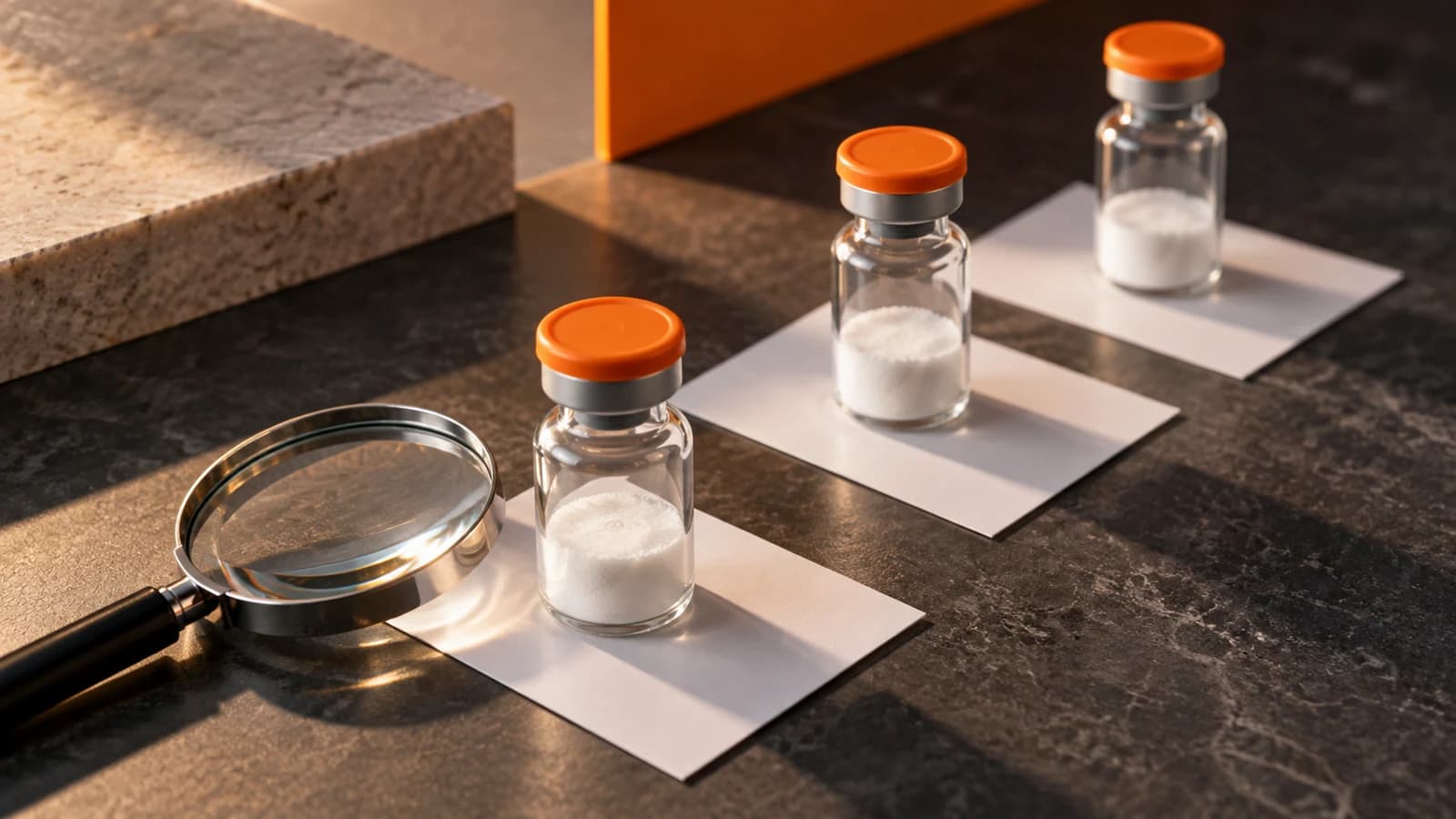
- Gross Cake Weight vs. Net Active Mass: A visually identical white lyophilized cake does not guarantee an identical active dose. Analytical laboratories measure net active peptide mass via quantitative HPLC, distinguishing active sequences from residual counter-ion salts, structural moisture, and cryogenic bulking agents (such as mannitol).
- pH Drift & Cross-Reconstitution Warnings: Unchecked counter-ion acidity drops the reconstituted solution pH, which can trigger localized stinging, subjective differences in biological tolerance, and even precipitation when combined with other compounds (such as TB-500 or KPV) in shared fluid pathways.
- The Repeat-Order Audit Protocol: Procurement teams and clinical buyers must demand a four-point verification on every replenishment batch: distinct production lot identifiers, raw baseline HPLC chromatograms (≥ 99.0% purity), LC-MS exact molecular weight confirmation (1419.5 g/mol), and quantitative net content verification.
Across orthopedic wellness centers, aesthetic medical spas, private distribution channels, and peptide discussion boards—such as recent formulation debates on r/NTNPerformance regarding peptide stability and solution pH—a common operational frustration repeatedly emerges: Why does an initial order of BPC-157 deliver predictable, clean results, while a second batch purchased from the exact same vendor months later feels weaker, causes injection-site stinging, or behaves erratically upon reconstitution?
Purchasers often assume the supplier substituted a completely different compound or shipped an outright counterfeit. While rogue traders do exist in the unregulated broker sphere, the technical explanation within standard synthesis runs is often more insidious: uncontrolled batch-to-batch chemical drift. Suppliers trading generic re-sold vials frequently switch contract lyophilization batches, pass off unpurified crude TFA salts without proper counter-ion exchange, or provide outdated, recycled Certificates of Analysis (COAs) with altered dates.
At Torapep, our brand focus is dedicated to High-Integrity Tissue Regeneration & Orthopedic Research Compounds. Below, our synthesis and quality control chemists break down the analytical mechanics behind repeat-order discrepancies, explain how counter-ion pH shifts impact formulation compatibility, and establish a repeatable audit framework for incoming shipments.
1. The Root Causes of Batch-to-Batch Discrepancies
When an identical peptide sequence produces conflicting practical outcomes across consecutive orders, analytical chemists evaluate four primary failure modes:
                            ┌──────────────────────────────────────────────┐
                            │      Incoming Repeat Order Discrepancy       │
                            └──────────────────────┬───────────────────────┘
                                                   │
         ┌─────────────────────────┬───────────────┴───────────────┬─────────────────────────┐
         ▼                         ▼                               ▼                         ▼
┌──────────────────┐      ┌──────────────────┐           ┌──────────────────┐      ┌──────────────────┐
│ Net Content Drop │      │ Residual TFA Acid│           │ Counter-Ion Shift│      │ Physical Cake    │
│  (Gross vs. Net) │      │   (pH Dropping)  │           │ (Acetate vs. Free│      │   Collapse /     │
│ Active mg diluted│      │ Causes localized │           │  Unstable Salts) │      │ Moisture Ingress │
│   by excipients  │      │ stinging & PIP   │           │ Solvation shifts │      │ Hydrolytic decay │
└──────────────────┘      └──────────────────┘           └──────────────────┘      └──────────────────┘
A. The Gross Weight vs. Net Peptide Content Trap
A standard vial label stating "5mg" or "10mg" must represent pure active peptide substance. However, raw freeze-dried cakes are composite matrices containing:
- The target peptide chain (Gly-Glu-Pro-Pro-Pro-Gly-Lys-Pro-Ala-Asp-Asp-Ala-Gly-Leu-Val).
- Bound counter-ions (such as acetate or residual trifluoroacetate).
- Residual structural moisture (typically 3%--8%).
- Cryoprotectant bulking agents (such as mannitol or trehalose).
If Vendor Batch A had a net peptide content of 88% (delivering 4.4mg of active BPC-157 in a 5mg label vial) and Vendor Batch B dropped to 65% (delivering only 3.25mg due to excessive bulking fillers or bound salt mass), the downstream user experiences a 26% drop in active dose despite drawing the exact same volume of diluent.
B. Counter-Ion Imbalance and Acidic Stinging
During solid-phase peptide synthesis (SPPS), crude peptides are cleaved from resins using high concentrations of trifluoroacetic acid (TFA). Legitimate manufacturing facilities run automated ion-exchange chromatography to displace toxic TFA with biocompatible acetate (CH3COO-).
When discount suppliers skip or shorten the ion-exchange stage to cut production costs:
- Residual TFA counter-ions drive the reconstituted solution pH down to an acidic 3.5--4.5.
- This acidity causes pronounced post-injection pain (PIP), burning, and erythema.
- In cellular models, excess free TFA induces non-specific inflammatory signaling, distorting assay baselines.
C. Solution pH and Cross-Peptide Precipitation Risks
As highlighted in recent community discussions on r/NTNPerformance, researchers frequently combine focal tissue repair peptides in shared fluid administration pathways. For instance, pairing BPC-157 with TB-500 (Thymosin β-4 active fragment) is standard practice in musculoskeletal research.
When both compounds are synthesized as clean, neutral acetate salts (pH 6.2--7.0), they co-exist in aqueous solution without chemical interference. However, if a replenishment batch of BPC-157 contains high residual TFA while the partner peptide carries an alkaline counter-ion, the rapid pH shift can compromise peptide solubility, inducing micro-precipitation or accelerated hydrolytic chain cleavage over a 28-day refrigerated storage window.
2. Physical Inspection vs. Analytical Verification Matrix
Buyers cannot confirm chemical integrity through visual inspection alone. Use this matrix to audit repeat shipments:
Swipe or scroll to compare all columns.
| Parameter | Surface Visual Check (Unreliable) | Analytical Testing Requirement (Definitive) | Torapep Manufacturing Benchmark |
|---|---|---|---|
| Active Identity | Uniform white freeze-dried solid cake | Electrospray Ionization LC-MS ([M+H]+ detection) | Exact monoisotopic mass confirmation: 1419.5 g/mol |
| Chromatographic Purity | Colorless optical transmission upon reconstitution | High-Performance Liquid Chromatography (RP-HPLC) | ≥ 99.0% single resolved baseline peak; zero co-eluting shoulders |
| Actual Active Dosage | Reading the vial label ("5mg" or "10mg") | Quantitative UV Spectrophotometry vs. Reference Standard | ≥ 95.0%--105.0% of declared active peptide mass |
| Residual Counter-Ions | Smelling diluent or testing injection sting | Ion Chromatography / Headspace Gas Chromatography | TFA content < 1.0%; standardized acetate salt form |
| Atmospheric Seal | Visual check of aluminum flip-off crimp | Vacuum decay leak testing & inert nitrogen headspace check | Medical-grade N2 gas vacuum purge; zero moisture ingress |
3. The 4-Step Replenishment Audit for Sourcing Desks
To ensure clinics, compounding pharmacies, and research teams never inject unverified variance into their workflows, follow this four-point audit protocol on every incoming order:
Step 1: Verify the Unique Production Lot Identifier
Never accept generic product shipments that lack a specific, traceable production lot number stamped directly onto the vial label or box packaging. If Batch #1 and Batch #2 carry identical labels without distinct lot numbers, the vendor is operating an opaque inventory pipeline where multiple contract syntheses are commingled.
Step 2: Cross-Check Raw HPLC & LC-MS Chromatograms
Demand full-spectrum analytical documentation for each specific lot. A compliant Certificate of Analysis must present:
- A high-resolution Reversed-Phase HPLC chromatogram showing a single, sharp retention peak at a defined retention time (typically 10--15 minutes depending on the acetonitrile gradient), confirming purity ≥ 99.0%.
- A companion LC-MS spectrum confirming the molecular ion peak at 1419.5 g/mol with no truncated sequence fragments (N-1 or N-2 deletions).
- Red Flag: If the vendor provides a static, low-resolution PDF where the lot number, date, or purity percentage appears visually superimposed or blurry, the document has been altered.
Step 3: Audit Reconstitution pH
When preparing an incoming lot, measure the solution pH using calibrated micro-pH strips or a benchtop probe:
- Reconstitution in standard bacteriostatic water (0.9% benzyl alcohol) or sterile saline should yield a stable reading between pH 6.0 and 7.2.
- If the reading falls below pH 5.0, the lot suffers from incomplete TFA depletion and should not be administered or co-blended.
Step 4: Evaluate Excipient and Reconstitution Speed
High-purity lyophilized cakes freeze-dried under stepped cleanroom cycles hydrate within 10 to 30 seconds upon gentle introduction of diluent along the glass wall. If the cake requires vigorous shaking, forms persistent gummy clumps, or turns cloudy, the batch contains excessive unlisted excipients or has suffered moisture-induced thermal degradation.
4. Orthopedic Synergy: Deploying BPC-157 Alongside Multi-Pathway Peptides
In advanced musculoskeletal and sports medicine protocols, BPC-157 is rarely deployed in isolation. Clinical practitioners frequently layer synergistic compounds to address concurrent inflammatory and cellular migration pathways:
- Dual-Action Structural Regeneration: Pairing BPC-157 with Torapep TB-500 provides simultaneous focal angiogenesis and actin-mediated cellular migration. For streamlined workflows, evaluate our pre-standardized, co-lyophilized formulation: Torapep BPC-157 + TB-500 Dual Vials.
- Targeted Mucosal & Inflammatory Modulation: In complex soft-tissue or gut permeability models complicated by pro-inflammatory cascades, researchers frequently cross-evaluate BPC-157 alongside Torapep KPV, an alpha-MSH derivative engineered to downregulate leukocyte infiltration without endocrine disruption.
5. Sourcing Factory-Direct Integrity: The Torapep Benchmark
Whether you manage an orthopedic wellness clinic, direct a compounding supply network, distribute to local resellers, or run private laboratory investigations, you should never have to wonder whether your repeat order matches your initial batch.
Torapep enforces strict industrial manufacturing and analytical oversight across our complete Torapep Peptide Catalog:
- Multi-Cycle Ion Exchange: Every production batch of Torapep BPC-157 Vials undergoes thorough ion conversion to guarantee stable, sub-threshold TFA acetate salts that eliminate injection discomfort and prevent cross-compound precipitation.
- Hermetic Inert Gas Lyophilization: Our vials undergo multi-stage stepped freeze-drying and are vacuum-sealed under an inert nitrogen (N2) headspace in ISO-certified cleanrooms, preventing moisture ingress and guaranteeing 24+ months of stability at -20°C.
- Public, Transparent Traceability: We publish unedited raw HPLC and LC-MS spectra for every released lot. Clients can verify their specific vial data at any time via the Torapep COA Verification Portal.
- Institutional Fulfillment & Contract Synthesis: From standard 10-vial kits to bulk wholesale custom formulations detailed under our Custom Peptide Synthesis Desk and Wholesale & Private Label Services, Torapep provides reliable supply backed by fully insured, guaranteed DDP customs clearance corridors to North America, the UK, Europe, and Australia.
Eliminate Batch Variance from Your Supply Pipeline
Stop gambling on secondary resellers and generic unverified lots. Deepen your understanding of tissue repair mechanisms by reviewing our full technical dossier on the Torapep BPC-157 Research & Mechanism Hub, and inspect our rigorous factory protocols in our Quality Control & Analytical Testing Standards.
Ready to secure consistent, laboratory-verified inventory for your facility?
- Consult directly with our technical support team via our Live Sales Consultation Desk or through our Direct Contact Page.
- Submit an Institutional Tiered Quote Request today to lock in factory-direct pricing, custom kit configurations, and dependable, lot-traceable fulfillment on every repeat order.
Disclaimer: All compounds and formulations manufactured and distributed by Torapep are intended strictly for in-vitro laboratory research, analytical quality evaluation, and professional formulation testing (Research Use Only, RUO). They are not synthesized, approved, or sold for unapproved human consumption, clinical medical treatments, or veterinary therapeutics.